We have already discussed the numbers you need before bidding on an auction car: its market value when repaired, repairs, fees, transport and the maximum bid that leaves your chosen saving.
Those numbers tell me whether a purchase could work financially. I also want to know what this particular car has been through, and whether the records fit together.
That is what I mean by the car's story. How has its mileage changed? How long did the recorded keepers have it? What appeared in its MOT history? Has it been through salvage before the current auction?
At auction, I may never speak to the previous keeper or see a complete set of repair invoices. My decision has to use the evidence I can access: the listing, photographs, dated vehicle records and any inspection available for that lot. If an important inconsistency remains unresolved, there are other cars to compare.
This guide follows the illustrative auction report for a BMW 218i. The car details, history and prices are fictional demonstration records. They show how to read evidence together, not what happened to a real vehicle. Copart is the example buying route; the method applies to other auction cars too.
Previous adverts: compare dates, mileage and asking prices
An earlier advert can give me another dated view of the same vehicle. Where records are available, I compare its mileage, asking price, location, description and photographs with later evidence.
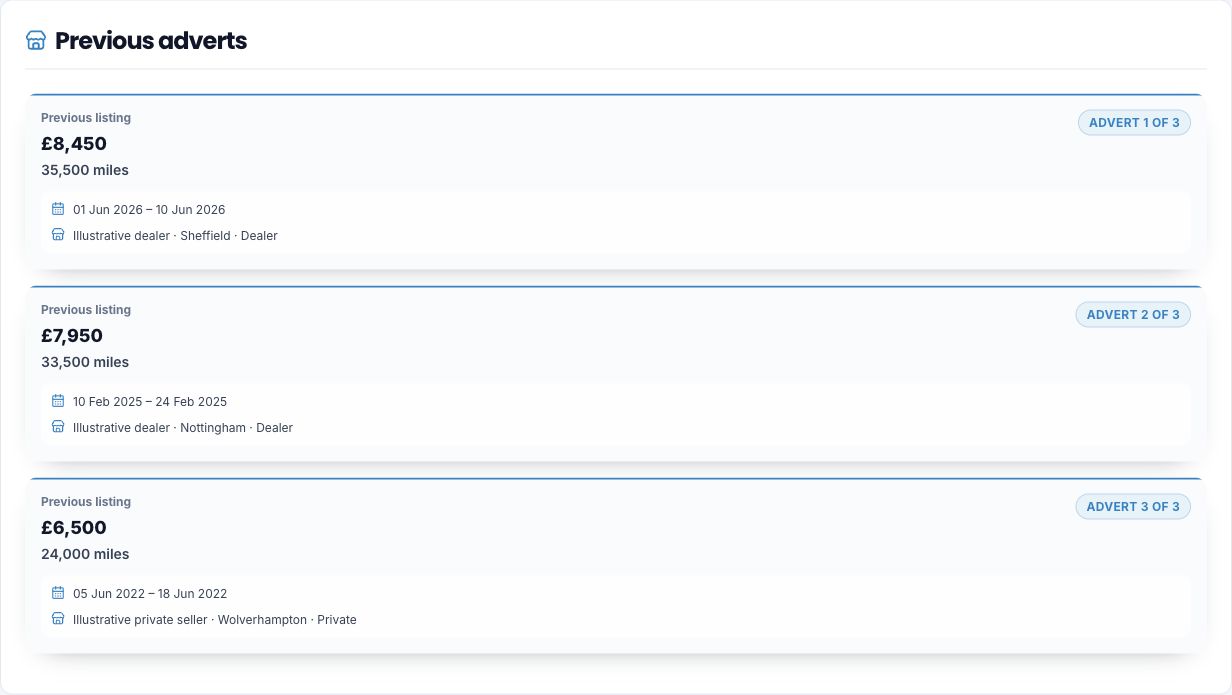
These are sample asking prices and advert records. They do not establish completed sales.
The sample contains three adverts:
| Advert date | Advertised mileage | Asking price |
|---|---|---|
| June 2022 | 24,000 miles | £6,500 |
| February 2025 | 33,500 miles | £7,950 |
| June 2026 | 35,500 miles | £8,450 |
The asking prices rise. I cannot conclude that the car sold at any of them, that it gained value, or that today's auction bid should follow them. Condition, repairs, seller type and the wider market can differ between adverts. I use the independent valuation for the price calculation explained in the numbers guide.
The more important finding appears when I compare the latest advert with the MOT history: the April 2026 MOT recorded 38,450 miles, but the June advert shows 35,500.
The later record is 2,950 miles lower. That needs resolving. It could be an advert entry error; it does not, by itself, prove the car was clocked.
I would compare the available dated records with the current lot information and any accessible odometer evidence. If that evidence still does not resolve the discrepancy, I would leave this example and look at another car. I do not need to prove wrongdoing to decide that the uncertainty is too much for me.
Keeper periods: look at duration, not just the count
The number of previous keepers tells only part of the story. Where dated changes are available, the duration helps me see whether the car stayed with each recorded keeper for months or years.
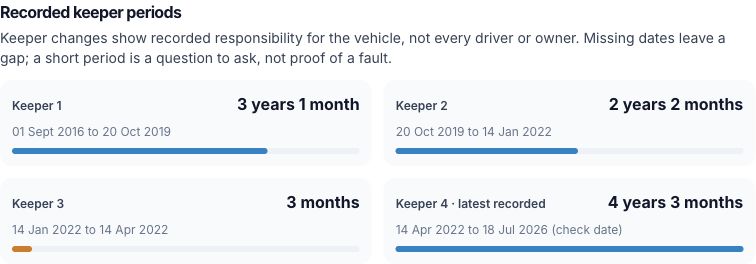
Three previous keepers plus the latest recorded keeper make four periods. A recorded keeper is not necessarily every owner or driver.
In this sample, the periods are roughly three years, two years, three months and four years. The short period is January to April 2022.
Three months does not prove a fault, neglect or an attempt to move a problem on. The record does not explain the reason for the change. I consider it alongside the other evidence rather than making it the verdict on its own.
Several short periods combined with other inconsistencies could make me less comfortable choosing a car. Longer periods might give me a clearer chronology, but they cannot establish that someone maintained it well. When dates are missing, that part of the story stays unknown.
MOT history: separate the recorded result from the explanation
The MOT record gives me dated mileages, passes, failures and recorded defects or advisories. GOV.UK's MOT history service is a useful starting point for those records.
In the sample, a front tyre advisory appears in both 2025 and 2026. That tells me tyre condition deserves attention when assessing the current car and its repair allowance.
It does not prove the same tyre remained on the car or that nobody fixed the earlier issue. Similar wording in two years is a recurring concern to examine, not a complete repair history.
There is also a brake-related failure on 28 March 2024, followed by a pass on 29 March. The record establishes a failed test and a successful retest. It does not show every repair undertaken, the parts used, or the brake condition today.
I read the MOT trail in date order and compare it with the advert mileages. Looking only at the latest pass would miss the discrepancy in this example. For the wider checks beyond auction buying, see the used-car checking checklist.
Salvage history: look beyond the current category
The current listing may describe one damage event, while earlier records show another.
This sample has an earlier Category S event in 2019 and a Category N event in 2026. The current front-end damage is therefore only part of its recorded history.
Category S describes repairable structural damage; Category N describes repairable non-structural damage. Copart's explanation of the ABI categories sets out that distinction. Neither label establishes the quality of a subsequent repair or the full condition of the car now.
I would compare the event dates, recorded damage and any available earlier images with the current listing and photographs. In this sample there are no historic salvage images, so I cannot use them to judge the earlier repair.
At auction, earlier repair paperwork may be unavailable too. That leaves a decision about the uncertainty I am willing to take on. If I want a simpler history, I can choose another lot. A low bid cannot supply missing evidence about repair quality.
Finance and stolen markers belong in the same picture
The sample returns no outstanding finance or stolen marker found. I want to see those checks alongside the mileage, MOT and damage history.
A clear result in one area does not resolve a concern in another. Here, the finance and stolen results do not explain why the later advert records fewer miles than the earlier MOT.
I also pay attention to whether a check completed, returned no marker, or had unavailable data. An unavailable result is a gap, not a clear result. Check the report date when using saved evidence for a purchase decision.
Put the records together, then make your decision
My picture of this example is now specific: two recorded salvage events, one short keeper period, recurring tyre advisories, a brake failure followed by a retest pass, and an unresolved mileage discrepancy between the MOT and an advert.
Some findings have several possible explanations. The records do not tell me why the car is being sold, and I would not invent a reason.
For me, the unresolved mileage discrepancy is enough to pass on this example and compare another lot. That is a separate decision from the financial maximum of £1,150 shown in the companion numbers example.
I want to be able to describe what the records establish, what I cannot establish, and whether I am willing to buy with those gaps. That gives me a more useful basis for choosing than either a reassuring score or an alarming record read in isolation.
How Ralph helps bring the story together
Ralph brings available vehicle records and auction listing evidence into a report so I can compare dates, mileage, markers and condition alongside the bid calculation. It helps me read the connections without reconstructing the whole history across separate pages.
The sample deliberately includes previous adverts for this walkthrough. Do not assume every illustrated section is included in every live auction report. Previous Advert History is a separate Custom check for auction buyers; select it when that is the evidence you need. Availability depends on the records returned for the vehicle. Missing keeper dates or historic adverts cannot be reconstructed as facts.
For the wider buying route, read how auction buying works. If you are also considering a dealer or private sale, how the buying channel changes the decision explains that context. This walkthrough stays focused on evidence an auction buyer can access.
Try it: Read the illustrative report alongside this guide, compare another car, or start a check for your chosen vehicle.