A repeated MOT advisory deserves attention before an auction bid, but it does not tell you the whole repair history. The useful question is whether you can understand the finding, assess its relevance to the car today, and allow for the work it may need.
We have already covered the numbers you need before bidding. MOT findings help you decide what belongs in the repair allowance behind those numbers. This guide focuses on reading that trail, rather than comparing free MOT checks with paid vehicle history.
Start with the exact finding
Open the detailed record, not just the latest pass badge. GOV.UK's MOT history service provides recorded test results and mileages. Read the description of each finding with its date.
GOV.UK explains that dangerous and major problems cause a failure. A pass may still include minor or advisory problems to monitor or fix. Those labels describe the test outcome; they are not a quote for putting the auction car right.
For each relevant entry, note:
- The component and its recorded location on the car.
- The description and severity at that test.
- Whether similar wording appears at a later test.
- The mileage and time between the entries.
- What the available current listing, photographs or inspection can establish.
Two entries about tyres may concern different corners of the car. Matching the words “tyre worn” is not enough to conclude that the same tyre remained fitted.
Work through the sample: a tyre concern in two years
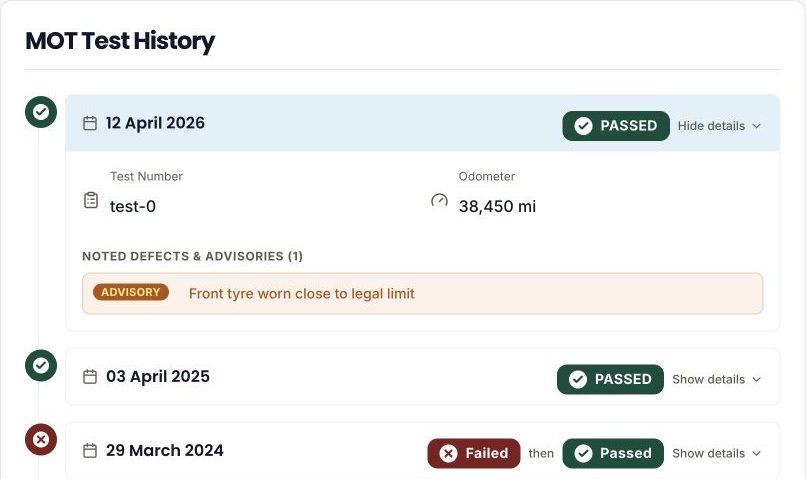
Original capture from Ralph's fictional sample report. It illustrates the reading method and is not evidence about a real auction lot.
In the sample, a front tyre advisory appears in 2025 and again in 2026. I would put tyre condition on my assessment list.
That repetition does not establish neglect. The tyre might have been replaced and worn again, or the entries might concern different circumstances. Without further evidence, I cannot reconstruct the work undertaken between the tests.
The practical consequence is a question for the current car: can I establish the condition well enough to price it? If not, my plan needs an allowance for that uncertainty. A photograph may show a tyre's sidewall without showing enough of its tread to answer the question.
A failure followed by a pass is a sequence, not an invoice
The sample also shows a brake-related failure on 28 March 2024 and a pass the next day. That establishes two dated results. It does not identify the parts fitted, who did the work, or the brake condition now.
I would avoid both extremes: treating the old failure as proof that the car is still faulty, or treating the next-day pass as a complete maintenance record.
Where the wording is unfamiliar, the DVSA MOT inspection manual explains the inspection areas and defect criteria for cars in Great Britain. It helps interpret a finding; it cannot diagnose today's car remotely.
Turn the trail into a buying decision
| What you find | What it establishes | Practical next step |
|---|---|---|
| Similar advisories in successive years | A concern was recorded more than once. | Match the component and location, then assess its current condition. |
| Failure followed by a pass | The recorded outcome changed between tests. | Keep the sequence in context; do not invent a repair invoice. |
| Latest pass with advisories | A successful test still recorded concerns. | Include relevant work in the present assessment. |
| MOT mileage higher than a later advert | Two dated records disagree. | Compare other available records before accepting the mileage story. |
| No finding about a component | That record contains no such finding. | Do not infer a complete mechanical inspection or service history. |
At auction, you may not have access to the previous keeper or repair paperwork. Use whatever inspection access the venue offers and the evidence available for the lot. If you cannot resolve a concern that matters to your decision, comparing another car is a valid outcome.
Convert a finding into an allowance without inventing a diagnosis
Suppose an illustrative repair plan totals £1,400 and already includes £250 for tyre work. If the repeated advisory concerns those same tyres, adding another £250 would count that job twice. If the scope excludes them, a current quote or an explicitly provisional allowance belongs in the plan before recalculating the bid.
These are fictional planning amounts, not tyre prices or a diagnosis from the MOT wording. Keep the component, work and evidence next to the allowance so you can see what it covers. A concern that cannot be priced or assessed well enough may be a reason to choose another car rather than invent a reassuring figure.
Compare dated mileage readings alongside the findings. Test frequency and repeated wording cannot explain a later lower reading by themselves.
Connect the history to the maximum bid
Read the MOT trail alongside any available previous adverts and the wider vehicle story. A reassuring test result does not explain a conflicting later mileage, and a clear finance result does not resolve a repair concern.
Ralph brings available history and auction evidence together so you can read the findings alongside the costs. It does not turn an old test into proof of today's mechanical condition.
Try it: Open the illustrative auction report, then use the numbers guide to see how repair costs affect the financial ceiling.
Official MOT result guidance rechecked on 5 October 2026. The worked examples use fictional demonstration records and planning amounts.