Start with the free MOT history to read the dated test results and mileage. Use the appropriate vehicle history checks for questions such as finance, stolen markers and recorded write-offs. Then assess the current lot and its total costs before setting a bid. These sources answer different questions about the same car.
A free check is useful evidence. The important thing is knowing which conclusions that evidence supports, rather than assuming every clear-looking result describes the whole vehicle.
What the free MOT record can show
GOV.UK's MOT history service lets you check recorded test results, mileage, failures and other test findings, along with the next test due date. Its coverage differs by location and period: the service describes results from 2005 for cars, motorcycles and vans in Great Britain and from 2017 in Northern Ireland.
For an auction buyer, the dates make this information particularly useful. They let you compare earlier mileages with the current listing and look at the sequence of recorded defects and retests.
Read the details rather than stopping at the latest pass. A later pass records a successful test at that time; the trail can still contain information worth considering for the present repair allowance.
What it does not establish
MOT history alone does not establish whether the car has outstanding finance, a stolen marker or an insurance write-off record. Those questions require their relevant record sources.
It is also not a complete service history. A failed test followed by a pass records the two outcomes, but does not identify every part fitted or every repair carried out between them. An advisory repeated later does not prove that nobody addressed the first one.
| Your question | Useful evidence to look for |
|---|---|
| What mileage was recorded at a dated test? | MOT history, compared with other dated records. |
| Did it fail or receive advisories? | The detailed MOT findings and later results. |
| Is there outstanding finance or a stolen marker? | The relevant licensed vehicle history checks. |
| Has it been recorded as a write-off? | Write-off records and category information. |
| Did it appear in an earlier advert or salvage record? | Those separate available historical sources. |
| What damage and costs do I face now? | Current listing evidence, photos, repair scope and appropriate quotes. |
| What should I bid? | Valuation plus total costs, reserve and the saving you want to preserve. |
The sources may overlap in a paid report, but their meanings remain distinct.
Compare mileage across records
In Ralph's illustrative sample, an April MOT records 38,450 miles. A June advert then displays 35,500 miles. The later number is lower.
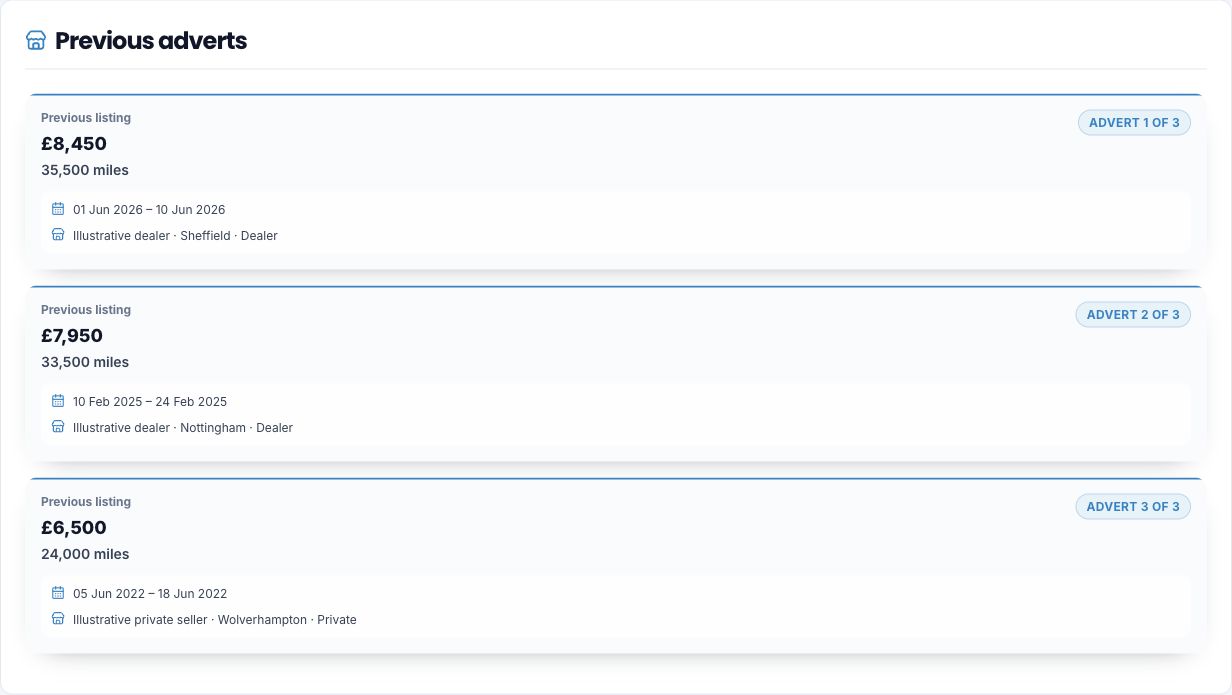
Original sample-report capture. The records demonstrate how to compare dates; they are not evidence about a real vehicle for sale.
That discrepancy needs explaining. It might be an entry error; it does not prove clocking. If the available evidence cannot resolve it, an auction buyer can decide to leave the lot without proving the cause.
The story guide walks through the sample's chronology. It also explains how keeper periods, salvage records and MOT findings add context without revealing every reason the car changed hands.
A paid check still needs its coverage read
Paid products have different inclusions. Confirm that the plan you choose checks the markers you need, and distinguish a completed check with no marker found from a result that was unavailable.
Ralph's Auction Bid Report, Premium Check and selected Custom checks have different scopes. Previous Advert History is a separate Custom check for auction buyers. Its inclusion in the demonstration report is not a promise that every live auction report contains it.
The same principle applies when comparing providers. For example, TotalCarCheck's product table distinguishes Gold from its other offerings. A low headline price does not by itself identify the coverage you would receive.
A record returned without an adverse marker is useful, but it does not establish the condition of hidden mechanical components. History checks and current condition evidence work together.
Set the bid after considering the evidence
Once you have a story you can accept, work through the numbers: market value when repaired, estimated repairs, transport, auction charges, other planned costs and a reserve.
Ralph brings those inputs into an auction calculation and lets you change the target saving in the report. The numbers guide explains the maximum bid and the circumstances that produce Do not bid.
A clean-looking history cannot create room in an expensive repair budget. A low price cannot supply an explanation for unresolved history. I need both the evidence and the arithmetic to be acceptable.
If you are choosing a paid provider, compare Ralph with VCheck, VehicleScore or TotalCarCheck. Each comparison identifies its public sources and what we have not tested.
A practical order before bidding
- Confirm the vehicle identity, listing mileage and available lot information.
- Read the free MOT trail in date order.
- Select the background checks relevant to your concerns and buying route.
- Compare any available adverts, keeper periods and salvage records with the current evidence.
- Establish a repair scope and transport allowance, then check the charges applying to the lot and your account.
- Set a financial ceiling and leave the car if the evidence or actual bidding does not fit your plan.
For the wider auction process, see buying a car at auction in the UK. For checks across other buying routes, use the used-car checklist.
Next step: Check the official MOT history, inspect Ralph's illustrative auction report, or start a check for your chosen car.