A cheap auction car still needs a mileage story you can understand. If the current reading and earlier records disagree, I would establish what the evidence actually shows before using that mileage to value the car.
At an auction, I may have no access to a previous keeper or a folder of invoices. My decision has to work with the information available before the sale. I do not need to solve every unexplained record to decide that another lot would suit me better.
Start with a dated sequence
The GOV.UK MOT history service includes the mileage recorded at tests. Compare those entries with the current auction listing and any available previous adverts.
For each reading, keep the date, source and unit visible. Also check that the record belongs to the registration or VIN you are considering. A number detached from its source is harder to interpret.
| Record | What I would retain |
|---|---|
| Earlier MOT | Test date, recorded mileage and unit. |
| Later MOT | The next dated reading, including any failure or retest entries. |
| Previous advert, when available | Advert date and stated mileage, keeping it separate from a tested reading. |
| Current auction listing | Listed mileage, its unit and any qualification in the lot description. |
Previous Advert History is a separate Custom check in Ralph. Its inclusion in the illustrative auction sample does not mean every live auction report automatically includes it. The story guide explains how I use the available records together.
A consistent sequence still has limits
A set of rising readings is a useful consistency check, not certification that the current odometer is genuine. Keep gaps in the record visible: no test entry for a period is not the same as evidence that the vehicle was unused. Ask what the available dated records establish rather than filling missing periods with a story.
For an imported vehicle or a listing using another unit, retain the original reading and unit before making a comparison. A current auction description is a separate source from the MOT database. Record any qualification in the lot description alongside the number instead of silently treating it as a verified reading.
The recurring-advisory guide explains how to read the findings that accompany that mileage trail. Neither a neat sequence nor a recent pass provides a complete maintenance history.
A later lower reading needs an explanation
In Ralph's illustrative sample, an April MOT records 38,450 miles, while a June advert states 35,500 miles. The later advert is 2,950 miles lower.
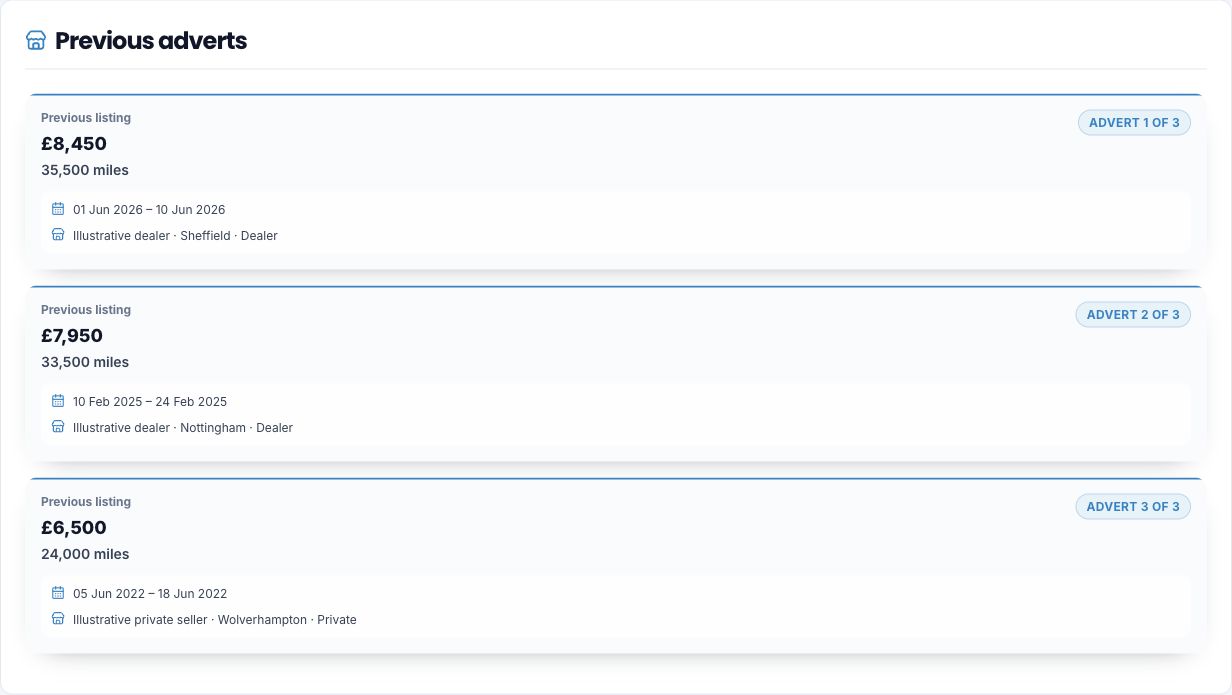
Original sample-report capture. The vehicle and records are fictional and illustrate a discrepancy; they do not make an allegation about a real seller.
That is enough for me to pause. It does not prove the odometer was altered. An advert error, a recording error or another documented explanation may exist. The important point is that I have not yet established which reading to rely on.
I would also check miles versus kilometres before comparing numbers. If the units differ, put the readings on the same basis and retain the original entries. Do not treat a unit difference as a mileage reversal.
Recording errors are possible, but evidence matters
DVSA provides a process for correcting mistakes on MOT records. Its guidance requires supporting evidence for older mileage corrections. That makes a recording error a possibility to investigate, rather than a convenient explanation to assume.
For an auction decision, I would review any correction or supporting documentation actually available. A comment saying “probably a typo” does not give me the same basis as a corrected record or dated evidence.
A bid discount does not resolve the discrepancy
Mileage helps anchor the valuation. If I cannot establish which mileage is appropriate, simply reducing my bid by an arbitrary amount leaves the original uncertainty intact.
Ralph helps show the available history alongside the valuation and bid calculation. I read a positive financial ceiling as a cost-plan result, not a clearance of every historical concern. The market-value guide explains why an uncertain valuation input matters.
Decide before the sale
My practical sequence is:
- Match vehicle identity and compare the dated readings and units.
- Review any available correction or documentation that reconciles them.
- Revisit the valuation and cost plan if the reliable mileage differs from the original input.
- If the inconsistency remains unresolved before bidding, choose whether to leave the lot.
I would pass on the sample's unexplained discrepancy. That is a decision about the uncertainty I am prepared to buy, not a claim that I have proven fraud.
For the wider history sequence, read the story behind an auction car. To distinguish the records from current condition, use free MOT versus paid vehicle history.
Next step: Explore the illustrative auction report and compare its dated records. For a live lot, decide whether the available evidence is sufficient before committing to a bid.