Market value when repaired estimates what the finished car could be worth. Your maximum bid is what you can pay at auction while leaving room for the planned costs and selected saving. They are different figures because the hammer price is only part of the money required.
This distinction matters when a lot's retail estimate looks attractive. A large gap between that headline estimate and the current bid can disappear once you account for history, condition, charges and repairs.
Establish what the valuation describes
A valuation has assumptions: vehicle identity, age, specification, mileage, condition and the market being described. Trade, retail, private-sale and auction figures are not interchangeable prices.
For a damaged auction car, also establish whether the estimate already reflects its recorded history. A comparable retail car without a write-off history may be a different proposition from the car you are considering after repair.
Ralph uses licensed market valuation data for its auction calculation. Where a category-adjusted estimate is available, that can provide the anchor. Otherwise a history adjustment can be applied with its basis identified in the report. Do not deduct a category adjustment again from a value that already includes it.
The listing's estimated retail value is another piece of information to examine. It should not automatically replace the independent valuation used for the calculation.
Three allowances people can confuse
| Allowance or adjustment | What it answers | What it changes |
|---|---|---|
| History or category adjustment | What could this repaired car be worth with its recorded provenance? | The valuation anchor. |
| Repair reserve | How much room am I keeping for uncertain costs? | The planned cost allowance. |
| Target saving | How far below the estimated value do I want the total planned spend to stay? | The room available for a bid. |
A 25% target saving is not another label for a write-off adjustment. Changing your target does not change the car's recorded history or make the market value rise.
It is also different from the reserve. The reserve addresses uncertainty in costs; the target saving is the gap you want to retain after the costs included in the plan.
Work backwards from the total you can spend
In Ralph's illustrative auction sample, the market value when repaired is £5,220. A 25% target leaves £3,915 for the entire planned purchase.
That amount must accommodate the auction bid, relevant charges, transport, repairs, other planned costs and the included reserve. Fees can change as the bid changes, so finding a ceiling requires checking the whole calculation rather than deducting one fixed charge.
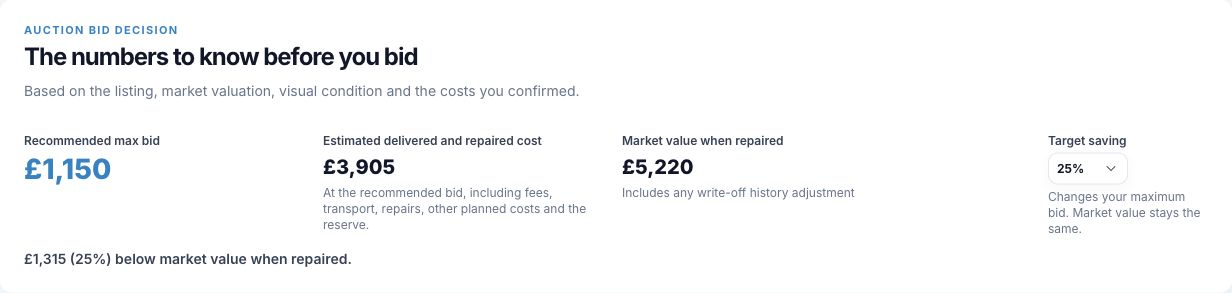
Original sample-report capture. These are demonstration figures and assumptions, not a live valuation or workshop quote.
The sample's recommended maximum is £1,150, with an estimated delivered and repaired total of £3,905. The £1,315 gap is about 25% of the repaired market value; rounding and the bid calculation affect the precise result.
The £5,220 figure therefore does not imply a £5,220 auction budget. Spending that much on the bid would leave the other planned costs still to pay.
For the wider calculation and source labels, read the numbers to know before bidding.
Changing the target changes the ceiling
Ralph's report lets you select 0%, 10% or 25% as the target saving. You can adjust it while reviewing the report.
At 10%, the same £5,220 valuation leaves £4,698 for the total planned purchase. At 0%, it leaves £5,220. Those totals are not maximum bids: you still need to fit the planned costs and bid-dependent charges inside them.
Reducing the target may allow a larger bid. It does not confirm that the repair estimate is sufficient, that the car will sell for the valuation, or that buying it will make a profit. Further costs and a different eventual sale price can change the outcome.
Why do not bid can be the useful answer
Consider a hypothetical change to the sample: repair, transport and relevant cost allowances already require £4,000 before any positive vehicle purchase price.
At a 25% target, the £3,915 total allowance cannot cover that plan. There is no positive bid that makes the selected target work, so Do not bid is a meaningful calculation result.
First check the inputs: mileage and vehicle identity, the valuation basis, repair scope, transport and the applicable charges. If those inputs are sound, changing the label cannot make the purchase fit.
Missing valuation is a different problem. Without a usable anchor, a report cannot establish the same financial ceiling. That should not be confused with a completed calculation showing the purchase is unworkable.
A positive ceiling is still only a ceiling
A small positive maximum does not predict that the seller or other bidders will accept that price. If bidding exceeds your ceiling, you can leave the lot.
A workable number also does not settle the car's history. The companion story example shows an unresolved mileage discrepancy in the same illustrative vehicle. I would pass on that uncertainty even though the sample displays a positive financial maximum.
The report helps separate those decisions: what fits the cost plan, and whether the evidence describes a car you are willing to buy.
Next step: Open the illustrative auction report, compare the valuation with the planned total, and try the target-saving control. Use the auction buying guide for the wider purchase process.