Watch the worked example
In this 11-minute walkthrough, I assess a real auction listing and explain why Ralph says do not bid. The figures below come from a separate illustrative sample report.
Watch on YouTube ↗You have found an auction car you like. The current bid looks low, the damage looks manageable, and you are thinking about what it might sell for once repaired.
Before joining the bidding, I want to know something more useful: what is the most I can pay for this particular car and still make the purchase worthwhile?
That answer needs more than the auction price. It needs the car's market value when repaired, the cost of getting it home and fixing it, the auction charges, and room for uncertainty. Without those numbers, I am bidding on a hope.
Ralph brings the available valuation, listing evidence, repair estimates and auction costs into one report. This guide explains how I read that report and turn it into a bid decision. The approach applies to auction cars generally; Copart is the worked example. For the buying process itself, start with how car auctions work, their costs and risks.
Prefer to watch? Follow my real Copart maximum-bid walkthrough on YouTube. The car in the video receives a do not bid decision; the sample figures in this article illustrate a different car.
Start with what the car could be worth when repaired
The market value when repaired anchors the calculation. It is an estimate of what this car could be worth after the planned repairs, with its recorded history taken into account.
It is different from the price of an otherwise comparable car without a write-off history. It is also different from an auction listing's estimated retail value.
Ralph uses licensed market valuation data rather than treating the auction listing's retail estimate as an independent valuation. Where a category-adjusted resale estimate is available, that becomes the anchor. Otherwise, Ralph can apply a history adjustment to the retail valuation and identify that basis in the report. A category adjustment must not be applied twice to a value that already includes it.
That distinction matters. If I overestimate what the finished car will be worth, I can justify a bid that the real economics will never support.
Count what it takes to get the car home and repaired
The purchase price is only one part of the spend. I also need to account for:
- Replacement parts, fitting, bodywork, paint and any specialist work identified in the repair scope.
- Transport or collection, using the quote and VAT treatment that apply to my purchase.
- Auction buyer, bidding and retrieval charges, plus applicable VAT.
- Other planned costs I have included in the calculation.
- A reserve for uncertainty, including damage the photographs may not reveal.
Auction fees can change as the hammer price changes. For Copart, I check the official member fee schedule rather than assuming one fee applies at every bid.
Repair estimates also need context. On a live check, Ralph can research comparable eBay parts offers and show the sourcing evidence. A listing with unconfirmed fitment is a candidate to investigate, not proof that the cheapest part will fit. Delivery, condition, model year, sensors and part numbers can all affect whether an offer is useful.
Parts prices do not establish the full workshop bill. Labour, paint and specialist allowances may still use AI estimates or older seller prices, and photos cannot establish every hidden repair. I read the source labels and the scope before relying on the total.
Keep target saving separate from the car's history adjustment
These answer different questions:
The history adjustment asks what the repaired car is worth with its recorded provenance. It changes the valuation used as the anchor.
Target saving asks how far below that value I want my total planned spend to be. It changes how much room remains for a bid.
Ralph's report offers target saving choices of 0%, 10% and 25%. The default is 25%, and I can change it in the report. Changing that selection recalculates the maximum bid; it does not make the car worth more or remove its history.
A 25% target saving is also different from a reserve for unknown damage. The reserve allows for uncertainty in the costs. The target saving is the gap I want to preserve after those planned costs and the reserve.
That gap is not guaranteed resale profit. The sale price may differ from the estimate, and further costs can arise. At 0%, I am asking for no target gap against the estimated value; I am not making the purchase risk-free.
Read the three headline numbers together
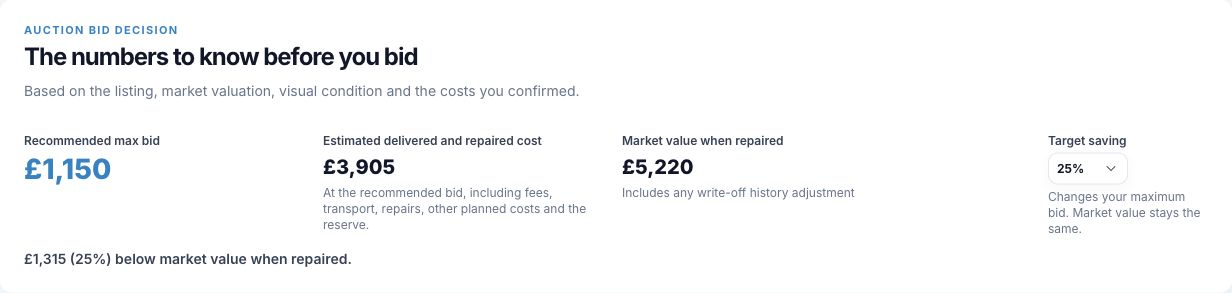
Cropped from Ralph's illustrative auction sample. These are demonstration figures, not a live valuation or repair quote.
In this sample auction report, the numbers are:
| Figure | What it tells me |
|---|---|
| Recommended max bid: £1,150 | The financial ceiling under the selected inputs. |
| Estimated delivered and repaired cost: £3,905 | The planned total at that recommended bid, including the reserve. |
| Market value when repaired: £5,220 | The estimated value against which the spend is compared. |
At that bid, the planned total is £1,315 below the repaired market value, about 25%. The exact percentage is affected by the bid calculation and rounding.
The process works backwards: begin with the repaired market value, preserve the selected saving, allow for repairs, transport, fees and the reserve, then find the bid that fits. Because auction fees depend on the bid, it is not simply a matter of deducting one fixed fee.
The sample also shows a current auction bid of £4,600, already above the £1,150 ceiling. A recommended maximum is not a prediction that the car will sell for that amount. If other buyers are paying more than works for me, I leave the lot.
What if Ralph says do not bid?
Sometimes there is no positive bid that meets the selected saving once the planned costs are counted. Ralph then shows Do not bid.
For example, using the same £5,220 market value, a 25% target leaves £3,915 for the entire planned purchase. If a different repair and transport scope already requires £4,000 before any positive purchase price, that target cannot be met. This is a hypothetical change to the sample, not its displayed repair estimate.
I would first check whether the inputs are right: the vehicle identity, valuation mileage, repair scope, transport and fees. If they are right, the result is useful. It means this car does not work under that plan.
Reducing the target to 10% or 0% may produce a positive maximum. But a tiny positive bid is still a ceiling, not a reason to chase a car that is already selling far above it. Changing the dropdown cannot turn an expensive repair into a cheap one.
A workable bid still needs a story I can accept
Even if the numbers allow a bid, I want to understand the car's history. Earlier salvage, inconsistent mileage or unexplained gaps may leave uncertainty I do not want to buy.
The same sample used here has an advert mileage below an earlier MOT reading. That is why the companion guide, the story behind an auction car, looks beyond the financial ceiling and explains why I would pass on this example.
A maximum bid tells me what fits financially. It does not require me to buy the car.
Check the inputs before the auction
Before relying on the result, I confirm the registration or VIN and mileage, check the valuation basis, review the damage and repair allowances, enter a suitable transport quote, and check the lot's VAT treatment and the charges for my account. I then choose a target saving and compare the ceiling with the actual bidding.
Ralph brings those inputs together so I can see the working instead of assembling a decision from disconnected tabs. Provider availability and vehicle coverage can leave gaps; the source labels and missing-data notes matter as much as the headline number.
For the fees, use Copart's published member fees and calculator. For the distinction between the buying routes, read auction vs dealer vs private: the same car, a different decision.
Try it: Explore the illustrative auction report, or start a check for the car you are considering.