Cat S and Cat N tell you the type of recorded damage category. They do not tell you the complete repair bill, the quality of an earlier repair, or the price the car will achieve after the current work. Those are separate questions to answer before an auction bid.
We have already covered the numbers you need before bidding and the story behind the car. Salvage history connects the two: it affects the evidence you want to understand and the valuation assumptions behind your financial ceiling.
What Cat S and Cat N mean
GOV.UK's write-off guidance identifies Category S as repairable following structural damage and Category N as repairable following non-structural damage. Both require repair to a roadworthy condition before being used again.
| Category | Recorded distinction | What you still need to establish |
|---|---|---|
| Cat S | Repairable structural damage. | The affected structure, work needed and evidence of any previous repair. |
| Cat N | Repairable non-structural damage. | The actual components affected and the full present repair scope. |
“Non-structural” is not a budget. A Cat N listing might still leave you unable to identify all the work required from photographs. Likewise, one Cat S label does not make every car in that category an equivalent repair job.
Read the lot's damage information, images and documents together. Use whatever inspection access the auction venue makes available. If you cannot assess an important part of the scope, that uncertainty belongs in the decision.
Read earlier events as well as the current listing
Ralph's fictional sample shows an earlier Cat S event in 2019 and a Cat N event in 2026. The current front-end damage is only part of that demonstration car's recorded story.
Two dated category records do not, by themselves, reconstruct two complete accidents. Nor does an earlier auction appearance necessarily prove a separate collision: a vehicle can appear for sale more than once. Match dates, identifiers and any available damage descriptions before drawing a conclusion.
In the sample there are no historic salvage photographs. I cannot use a missing photograph to certify the earlier repair. The record establishes the illustrated history; the quality and full scope of that repair remain unknown.
If that uncertainty is more than I want to take on, I would choose another lot. A low purchase price cannot create the missing evidence.
Keep resale value separate from repair costs
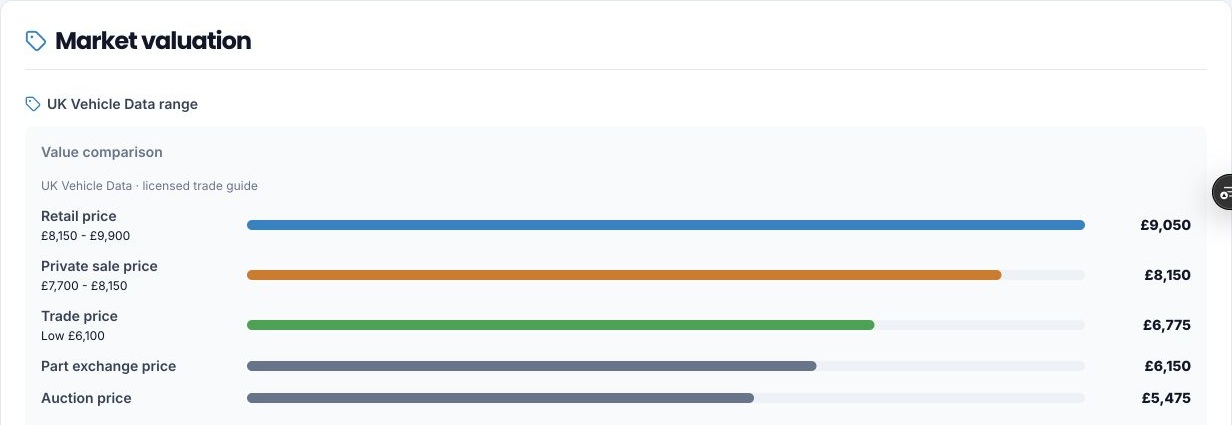
Original fictional sample-report capture. Displayed valuation assumptions illustrate the method, not a guaranteed sale price.
The amount spent repairing a car does not determine what someone will pay for it afterwards. Start with relevant valuation evidence, then consider comparable cars with similar history, specification and condition.
The Department for Transport's guide to repaired write-offs discusses the importance of condition and value when buying a previously written-off vehicle. It also recommends getting an insurance quote before buying so the premium does not undermine the expected saving.
Avoid presenting a percentage adjustment as a universal rule. If a calculation assumes a reduction for salvage history, make that assumption visible and check whether relevant market evidence supports it. The category alone does not supply an exact discount.
A salvage value adjustment is not your target saving
These percentages answer different questions:
- A valuation adjustment estimates what this car could be worth when repaired, accounting for its history and other relevant assumptions.
- Your target saving determines how much below that estimated value you want the planned total purchase to remain.
Applying a salvage adjustment does not mean your personal saving has already been secured. You still have to buy, transport and repair the car, pay the applicable charges, and allow for uncertainty.
Ralph's report lets you choose a target saving of 0%, 10% or 25%. That choice changes the bid calculation; it does not rewrite the vehicle's category or establish a new market price. The market value and maximum bid guide explains this distinction in more detail.
A valuation adjustment and a saving are separate steps
Consider invented figures: comparable cars without the recorded history suggest £8,000, and a documented assessment of this particular repaired vehicle produces a £6,400 valuation. That £1,600 difference is a valuation assumption, not money the buyer has already saved. The illustration does not establish that all Cat S or Cat N cars lose 20% of their value.
If the buyer then chooses a 25% target saving, the planned total purchase needs to stay within £4,800, calculated from the £6,400 repaired value. Repairs, transport, applicable auction fees and the reserve must fit alongside the hammer price inside that total. A £6,000 total would be below the original £8,000 comparison but still miss this chosen target.
Keep the source of each number visible. If comparable evidence cannot support the assumed repaired value, the maximum bid is uncertain too. The auction fee guide illustrates why the remaining room cannot be treated as the hammer price alone.
Make the decision in a practical order
- Read the current lot category and damage evidence.
- Compare available earlier salvage records with that current event.
- Identify what you can and cannot establish about the repair scope.
- Estimate market value when repaired using relevant evidence and visible assumptions.
- Include repairs, transport, auction charges, other planned costs and a reserve.
- Preserve the target saving you want, then calculate the maximum bid that fits.
If the numbers leave no workable bid, the financial result is Do not bid. Even when they do leave room, unresolved damage or repair-history concerns can be a separate reason to walk away.
Ralph brings available history, listing evidence, valuation and estimated costs into the report so you can read those questions together. It does not certify hidden damage or the quality of a previous repair.
Try it: Read the illustrative auction report, follow the vehicle story, and review the numbers behind the maximum bid.
Official category guidance rechecked on 5 October 2026. The worked history, valuation assumptions and report figures are fictional demonstration data.