An IAA or SYNETIQ UK hammer price is only the beginning of the purchase calculation. Before bidding, establish which UK charges apply to your account and lot, then price the collection and repair plan.
IAA's UK buyer-fee page links to the UK auction marketplace, including SYNETIQ auction URLs. This guide uses that UK schedule, checked on 5 October 2026. It does not use the US IAA fee tables that can also appear in search results. The public heading says “Effective 1st April” without specifying a year; the checked date is our observation date, not an inferred effective year.
We have already covered the numbers to know before bidding. Here the narrower question is how to put the appropriate UK auction charges into that plan.
Establish your fee tier first
The official page has separate Standard Volume and High Volume buyer fees. Confirm the tier applied to your account instead of selecting the cheaper column. Its volume descriptions overlap at exactly 12 purchases, so a buyer at that boundary should ask the operator which tier applies.
For the example below, I use Standard Volume, assume no VAT on the vehicle's hammer price, and apply 20% VAT to the listed fees. Confirm the lot's VAT treatment separately. Membership, storage and other possible charges are outside this limited example.
A £100 bid increase can cost more than £100
| Cost in this example | £1,900 hammer price | £2,000 hammer price |
|---|---|---|
| Standard Volume buyer fee, before VAT | £300 | £330 |
| Admin fee, before VAT | £79 | £89 |
| Lot retrieval, before VAT | £50 | £50 |
| These fees including 20% VAT | £514.80 | £562.80 |
| Hammer price plus these fees | £2,414.80 | £2,562.80 |
The difference is £148, although the hammer price increased by £100. In this example, crossing the price band changes two charges as well as the bid.
Those figures are an explanation of the checked schedule, not an invoice or a promise about your account. The retrieval charge covers movement to the loading area; it is not a delivery quote. Include a quote for the actual journey in your total cost plan.
Does the total still fit your target?
Now consider a hypothetical car with an estimated market value when repaired of £5,500. A 25% target saving leaves £4,125 for the planned total purchase.
Suppose the £2,000 bid and the example fees produce £2,562.80. Add invented planning allowances of £1,200 for repairs, £240 for transport and £300 as a reserve. The total becomes £4,302.80, which is £177.80 above the chosen target.
The result does not meet that target. I would revisit the bid with its recalculated fees, or leave the lot. I would not make the numbers fit by deleting a cost I still expect to pay. The valuation and allowances here are fictional; they are not a repair quote or a market appraisal for a real vehicle.
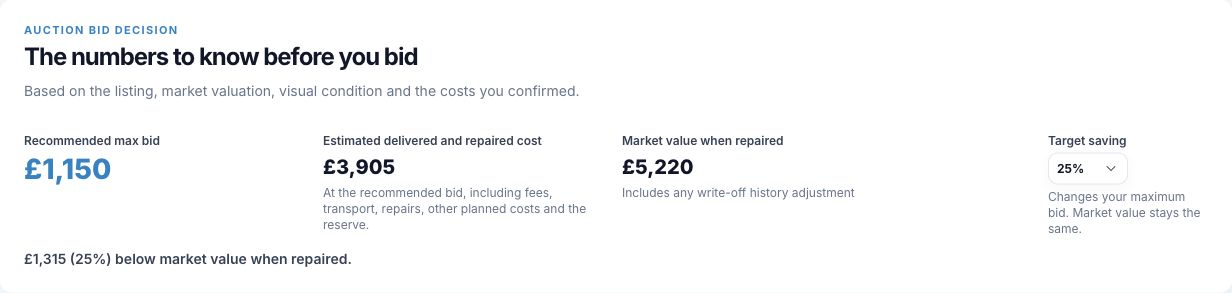
Original fictional sample-report capture. It illustrates the financial summary, not verified IAA fee calculation or the example above.
Where Ralph helps, and what needs confirming
Ralph's auction workflow connects available valuation and repair evidence to cost inputs and a target saving. That does not establish that every IAA or SYNETIQ URL extracts reliably, or that your account's charges have been reproduced correctly. Platform recognition alone is not an end-to-end test.
Review the identified source, entered costs and source labels. Reconcile the applicable auction charges against the operator's schedule before relying on the financial ceiling. If important fields or fee evidence are missing, treat them as unresolved inputs.
For the broader buying process, read buying a car at auction in the UK. For the distinction between repaired value and a bid ceiling, read market value versus maximum bid.
Next step: confirm your fee tier and lot treatment, obtain a collection quote, and review the illustrative auction calculation before committing to a bid.